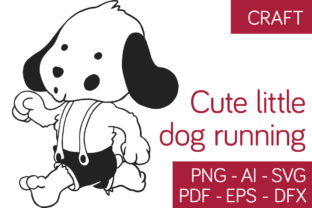
Little Cute Dog Running
As a designer who’s stitched hundreds of embroidery projects—from boutique baby onesies to Etsy best-selling tote bags—I opened Little Cute Dog Running expecting charm, but what stood out immediately was its energy. This isn’t just another cartoon dog silhouette. It’s a compact, joyful motion study: head tilted, ears flapping mid-stride, paws lifted like it’s chasing something delightful just off-canvas. The pose reads instantly—playful, friendly, unpretentious—and that’s gold for craft businesses building recognizable, emotionally resonant design assets.
First Impressions That Translate to Real Embroidery
The line work is clean and confident—not overly detailed, but intentional. There’s no fussy fur texture or micro-shading, which is smart. In machine embroidery design, simplicity often wins: fewer tiny satin stitch curves mean less thread breakage, cleaner stops/starts, and better performance on lightweight fabrics like cotton poplin or baby jersey. I visualized it right away on a natural linen tea towel—stitched in soft ecru thread—and it felt like the kind of detail that makes customers pause at a craft fair booth: “Oh! That dog looks like my terrier!” That emotional hook matters more than technical perfection when you’re selling handmade products.
Where It Shines (and Where It Needs Thought)
Little Cute Dog Running excels on stable, medium-weight substrates: cotton sweatshirts, canvas tote bags, denim aprons, and structured pillow covers. On a black crewneck, stitched in matte charcoal thread with a subtle white outline, it popped with warmth and clarity—no bleeding, no distortion. As an embroidered patch? Ideal. Its balanced proportions (roughly 3–4 inches wide in standard scaling) fit comfortably inside a 4x4 hoop without cramming, and the open negative space around the legs keeps fill stitch density manageable.
But let’s be real: it’s not universally forgiving. On highly textured fabrics—like bouclé knit or thick terry cloth—the running pose’s fine leg separation can blur. And on stretchy fabrics (think ribbed baby bodysuits), I’d recommend light cutaway stabilizer *plus* basting stitches before hooping—otherwise, that lifted-paw energy risks turning into a slightly sagging silhouette. Also, avoid placing it directly over seams or curved surfaces like cap fronts unless you’ve tested the file’s stitch path for puckering risk. The design’s forward momentum works best on flat, stable zones.
Commercial Use: What Your Customers—and Your Brand—Will Notice
If you’re an Etsy seller or small shop owner, Little Cute Dog Running strengthens your brand voice: approachable, cheerful, handmade-with-care. It doesn’t scream “mass-produced.” Stitched on a personalized gift—a baby’s first embroidered blanket or a holiday kitchen towel—it feels intentional, not generic. Buyers notice that. They also notice when details hold up after washing: the tail curve stays crisp, the eye shape remains distinct, and there’s no dense cluster of satin stitch that could stiffen fabric unnaturally. That translates to repeat trust—and fewer “why does this look blurry?” messages.
For apparel decorators adding custom embroidery to client orders, this design scales well. Enlarge it for a back-of-sweatshirt statement, shrink it gently for a sleeve accent—just verify the file maintains clean edges at both ends. Since it’s offered in DFX, SVG, EPS, PDF, AI, and PNG, you’ve got flexibility: vector formats for digitizing adjustments, raster for mockups, and PDF for quick client approvals. Just remember—PNG is for preview only; never stitch from it.
Practical Designer Notes Before You Hoop It
- Always test on scrap fabric first—especially if using dark thread on light fabric or vice versa. That contrast affects perceived sharpness.
- Check stitch density in the legs and tail. Overly tight fill areas can cause stiffness or skipped stitches on low-tension machines.
- Confirm hoop size compatibility. While it fits a 4x4 comfortably, double-check the actual dimensions in your embroidery software—some versions scale differently.
- Inspect small details: the eye, ear tip, and paw definition. If they vanish at 75% size, adjust your digitizing or choose a different placement.
- Test black-and-white mockups—not just color. Many buyers browse thumbnails first; does the shape read clearly in grayscale?
- Use appropriate stabilizer: tear-away for stable wovens, cutaway for knits or delicate items like baby clothes.
- Review licensing terms carefully. Since the listing notes “More characters in this style soon at my store,” confirm whether commercial use of finished products (e.g., selling embroidered dog towels) is permitted under the license.
A Design That Fits Into Your Workflow—Not the Other Way Around
Little Cute Dog Running doesn’t demand special treatment—but it does reward thoughtful execution. It’s not a “set-and-forget” graphic. It’s a crafts asset that invites collaboration between designer and machine: tweak thread colors to match nursery palettes, pair it with minimalist sans-serif text for a modern apron line, or layer it subtly behind a monogram for personalized gifts. As a digital embroidery file, it’s versatile. As a Graphics element in your product photography, it adds narrative—this isn’t just stitching; it’s storytelling.
I recently used a version of this design on a set of organic cotton kitchen towels for a local café’s gift shelf. Customers loved the movement—the way the dog seemed to “leap” across the fabric. One even asked, “Is that your dog?” That’s the quiet power of well-considered embroidery: it humanizes your craft business, turns functional items into keepsakes, and makes every finished product feel like a small, joyful exchange.
So yes—Little Cute Dog Running earns its place in your embroidery project queue. Not because it’s flashy, but because it’s functional charm: lively enough to delight, simple enough to execute, and distinctive enough to build recognition. Just treat it like the thoughtful design asset it is—not just another download, but a partner in your next handmade product launch.