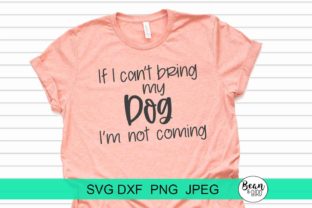
If I Can’t Bring My Dog, I’m Not Coming
Let’s be real: this isn’t just another cute dog-themed graphic. As a designer who’s stitched hundreds of custom embroidery projects—from boutique baby onesies to holiday market tote bags—I opened If I Can’t Bring My Dog, I’m Not Coming expecting charm, but what stood out immediately was its intentional simplicity. No frills, no overwrought script, no crowded icons—just bold, confident lettering with subtle personality. It lands somewhere between playful and defiant, which makes it unusually versatile for real-world embroidery use.
A Tote Bag That Starts Conversations (Before It’s Even Stitched)
Last week, I prepped a batch of linen-cotton blend tote bags for a local pet-friendly café pop-up. I chose If I Can’t Bring My Dog, I’m Not Coming as the centerpiece—not because it’s trendy, but because it reads cleanly at 4.5 inches wide and holds up under medium-density fill stitch. The phrase’s rhythm works in embroidery: short words, strong consonants (“Dog,” “Not,” “Coming”), and natural spacing that avoids cramped lettering. When stitched on a natural canvas tote with navy thread, it looked handmade but polished—not like a resized PNG slapped on fabric.
Where This Design Truly Shines (and Where It Needs Care)
If I Can’t Bring My Dog, I’m Not Coming is strongest when used as a standalone statement piece—not layered, not scaled down below 3 inches, and not forced into tight curves. Here’s how it performed across real applications:
- Sweatshirts & hoodies: Excellent. The clean block-style lettering avoids thin serifs or fragile terminals that snag on fleece loops. Paired with a medium-weight cutaway stabilizer, it stayed crisp through washing and drying.
- Tote bags & tea towels: Ideal. Linen, canvas, and cotton duck all handled the moderate stitch density without puckering. No satin-stitch outlines needed—the fill stitch alone gave enough definition.
- Baby items (onesies, burp cloths): Use caution. While the sentiment is lighthearted, the phrase’s tone may not suit infant gifting unless paired with soft visuals (e.g., a tiny paw print beside the text). Also, test thread color contrast carefully—light gray thread on heather grey onesies nearly disappeared.
- Caps & curved surfaces: Not recommended without digitizing adjustments. The current layout assumes flat embroidery. Attempting it on a front cap panel without re-angling the baseline led to uneven letter height and distorted spacing.
- Dark or textured fabrics: Works—but only with high-contrast thread (e.g., white or cream on charcoal). Avoid pastel threads on deep tones; they mute readability. Also skip heavy terry cloth or bouclé—those textures swallow fine detail.
What This Design Says About Your Brand (Without Saying a Word)
When your customer sees If I Can’t Bring My Dog, I’m Not Coming on a finished product, they’re not just reading a phrase—they’re sensing your design judgment. It signals confidence in minimalism, respect for legibility, and awareness of audience. Pet lovers recognize the humor instantly; non-dog owners still appreciate the clarity and wit. That dual appeal is rare in Crafts category graphics—and valuable for Etsy sellers building a cohesive shop identity.
But here’s the quiet truth: this design doesn’t elevate a weak product. Stitched poorly on low-grade poly-cotton with cheap stabilizer? It looks rushed. Placed awkwardly on a petite apron pocket? It overwhelms. Its strength lies in restraint—so your execution must match that energy.
Practical Embroidery Designer Notes (From One Maker to Another)
Before you load If I Can’t Bring My Dog, I’m Not Coming into your machine or list it in your digital shop, run through these checks:
- Test on scrap fabric first—especially if using textured weaves or blends. Note how the fill stitch settles and whether corners hold sharpness.
- Review stitch density in your embroidery software. If it’s above 12,000 stitches for a 4-inch version, consider simplifying small inner counters (like the “o” in “Dog”) to reduce thread buildup.
- Confirm hoop size compatibility. At full width, this design fits comfortably in a 5x7 hoop—but won’t scale gracefully into a 4x4 without losing letter proportion.
- Inspect small details in the PNG and SVG files. Since this is a Graphics asset meant for Cricut and Silhouette too, some versions may include decorative flourishes not optimized for stitching. Stick to the embroidery-specific file if one’s provided—or digitize from the cleanest vector layer.
- Try black-and-white mockups before finalizing thread colors. What reads well on screen often lacks contrast in thread-on-fabric reality.
- Use proper stabilizer: medium-weight cutaway for knits, tear-away for stable wovens. Skip iron-on patches unless the design has been specifically digitized for appliqué.
- Verify licensing terms before selling finished embroidered items or bundling the file for resale. The listing says it’s usable for mugs, signs, and door mats—but commercial embroidery rights aren’t automatically included unless explicitly stated.
Final Thought: A Design That Earns Its Place
If I Can’t Bring My Dog, I’m Not Coming isn’t flashy. It won’t win awards for technical complexity. But in the hands of a thoughtful maker—someone who values clarity, audience resonance, and honest craftsmanship—it becomes more than a phrase. It becomes a signature. A conversation starter on a sweatshirt. A quiet wink on a nursery pillow. A reason someone chooses your Etsy shop over three others.
That’s the mark of solid design assets: they don’t shout. They settle in, stay legible, and make the handmade product feel intentional—not incidental. Whether you’re embroidering for joy, profit, or both, this one earns its spot in your working library—if you treat it like the capable, understated tool it is.